GPT-Live and Full-Duplex Voice AI: What It Changes for Customer-Facing Businesses
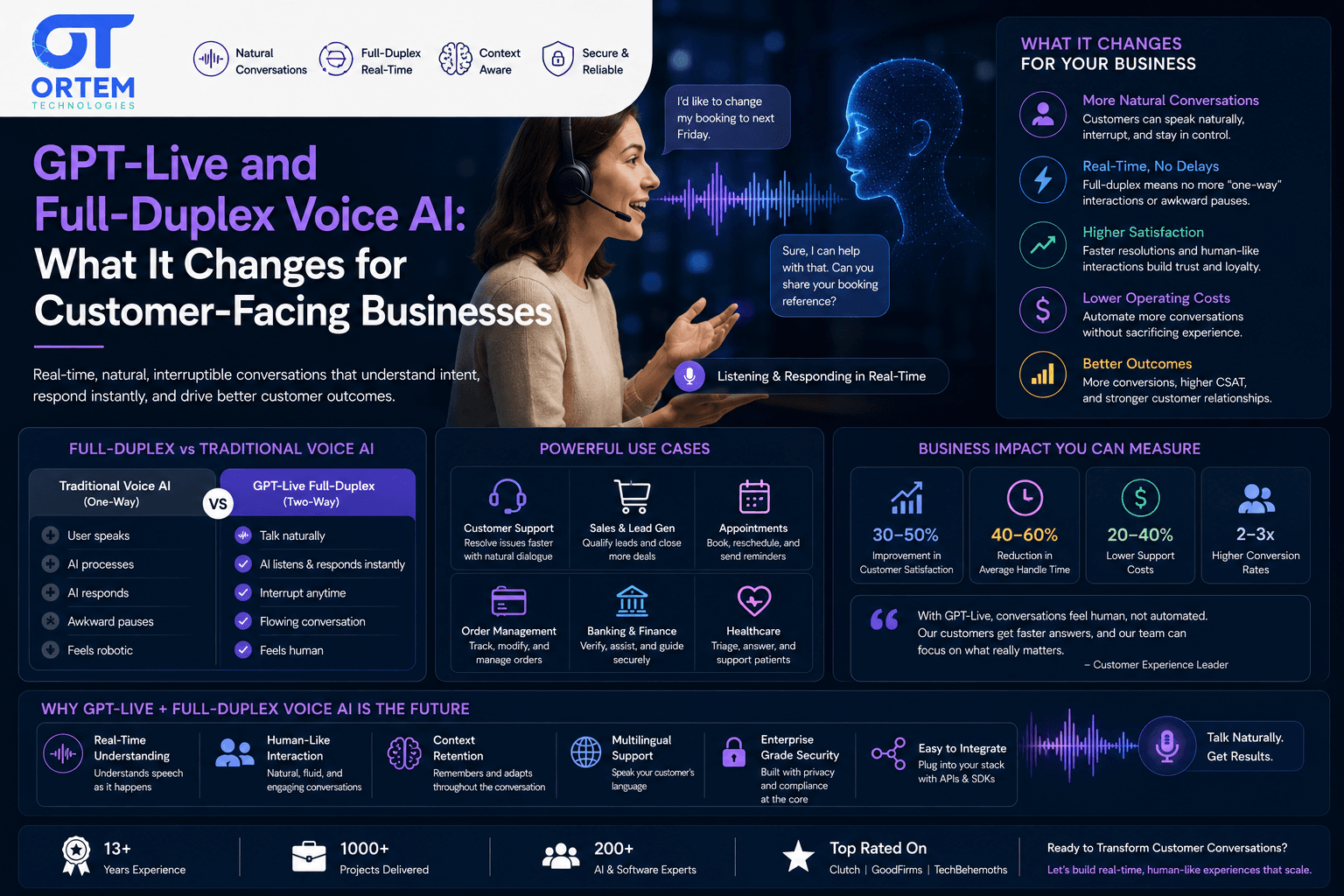
GPT-Live, announced by OpenAI in July 2026, is a voice AI built on a full-duplex architecture — it listens, reasons, and speaks at the same time instead of taking turns, and supports real-time translation, live web search mid-conversation, and delegation to other agents. For customer-facing businesses this removes the biggest quality ceiling in voice automation: the robotic turn-taking that made callers hang up. A production voice agent deployment (telephony, business-system integration, escalation, monitoring) typically costs $25,000–$80,000 to build plus usage-based running costs. Ortem Technologies has shipped production voice AI support agents and scopes these deployments end to end.
Full-duplex voice AI means the system listens and speaks simultaneously — handling interruptions, backchannel cues ("mm-hm", "actually, wait"), and mid-sentence corrections the way humans do — instead of the walkie-talkie turn-taking of earlier voice bots. OpenAI's GPT-Live, announced in July 2026, brings this architecture to the mainstream, alongside real-time translation and live task delegation to other agents.
Every voice bot you have ever hung up on failed the same way: it could not handle you interrupting it. You said "actually, wait—" and it kept talking. That failure was architectural — the system transcribed, then thought, then spoke, in sequence, like a walkie-talkie. OpenAI's GPT-Live, announced this week, is built full-duplex: it listens, reasons, and speaks at the same time, handles interruptions and mid-sentence corrections, translates in real time, searches the web mid-conversation, and can hand tasks to other agents while still talking to the caller.
Strip the launch gloss and the business meaning is concrete: the quality ceiling that kept voice AI in the "overflow and after-hours" tier is gone. Here is what that changes, and what deploying it actually involves.
What full-duplex changes in practice
Interruptions become normal conversation. Callers correct themselves, talk over the agent, change their minds mid-sentence. Turn-taking systems shattered on this; full-duplex absorbs it.
Dead air disappears. The half-second lag before every response — the tell that made callers ask for a human — collapses, because reasoning overlaps with listening and speaking.
Live actions during the call. Searching current information, checking a booking system, delegating a task to another agent — while maintaining the conversation. The call stops being a script and becomes an interface to your business systems, which is where our agent development practice does most of its work.
Language stops being a staffing problem. Real-time translation means one line serves every caller your business attracts.
What voice agents reliably own in 2026
The honest scoping rule: automate the high-volume, low-stakes tier completely; escalate the rest gracefully.
| Call type | Automation fit | Why |
|---|---|---|
| Booking & rescheduling | Excellent | Structured task, clear success criteria |
| Order/appointment status | Excellent | Lookup + read-back |
| Intake & triage | Strong | Collect, summarize, route to human |
| After-hours & overflow | Strong | The alternative is voicemail |
| Complaints, negotiations, emergencies | Escalate | High stakes, judgment-heavy |
Clinics, home services, logistics operators, and local multi-location businesses typically find 40–70% of inbound volume sits in the top four rows. That tier, automated, costs $0.10–$0.50 per call at usage-based rates against $4–$8 per human-handled call — and it never queues.
What a real deployment involves
The model is the smallest piece. A production voice agent needs telephony integration (your numbers, your routing), connections to booking/CRM/ticketing so the agent can act rather than chat, escalation paths that hand humans a summary instead of a cold start, disclosure and consent handling, and per-call monitoring with cost and resolution tracking — the same cost-per-resolved-task discipline from our agent budget guide.
Typical build: $25,000–$80,000 depending on integration surface and compliance (healthcare intake, for instance, pulls in HIPAA scope). Typical timeline: 6–10 weeks to production with a scoped call tier, not a boil-the-ocean receptionist.
We have shipped this pattern before the full-duplex era — our voice AI support agent case study covers a production deployment — and full-duplex removes the largest quality objection we used to scope around.
The bottom line
GPT-Live's full-duplex architecture makes voice agents conversationally credible for the first time. The winning move for customer-facing businesses is not a maximalist AI receptionist — it is picking the routine 40–70% of call volume, automating it completely with clean escalation, and measuring cost per resolved call from day one.
We scope and build production voice agents — telephony to CRM to escalation. See our AI agent development services and portfolio, or book a free consultation and we will segment your call volume and give you the automation math for your specific line.
About Ortem Technologies
Ortem Technologies is a premier custom software, mobile app, and AI development company. We serve enterprise and startup clients across the USA, UK, Australia, Canada, and the Middle East. Our cross-industry expertise spans fintech, healthcare, and logistics, enabling us to deliver scalable, secure, and innovative digital solutions worldwide.
Get the Ortem Tech Digest
Monthly insights on AI, mobile, and software strategy - straight to your inbox. No spam, ever.
Sources & References
- 1.AI News, July 13 2026 - BuildFastWithAI
- 2.AI Agent Development Services - Ortem Technologies
About the Author
Director – AI Product Strategy, Development, Sales & Business Development, Ortem Technologies
Praveen Jha is the Director of AI Product Strategy, Development, Sales & Business Development at Ortem Technologies. With deep expertise in technology consulting and enterprise sales, he helps businesses identify the right digital transformation strategies - from mobile and AI solutions to cloud-native platforms. He writes about technology adoption, business growth, and building software partnerships that deliver real ROI.
Frequently Asked Questions
- GPT-Live is OpenAI's voice AI announced in July 2026, built on a full-duplex architecture that listens, reasons, and speaks simultaneously rather than in turns. It supports real-time translation, live web search during a conversation, and delegating tasks to other agents mid-call. It is aimed at real-time conversational applications — support lines, assistants, and voice interfaces.
- Reliably in 2026: appointment booking and rescheduling, order status and FAQs, intake and triage (collecting details before a human callback), after-hours coverage, and multilingual reception. The pattern that works is scoped automation with clean human escalation — the agent fully owns routine calls and hands off edge cases with a summary, rather than pretending to handle everything.
- A production deployment — telephony integration, connection to your booking/CRM/ticketing systems, escalation paths, monitoring, and evaluation — typically runs $25,000–$80,000 to build, depending on integration count and compliance requirements. Running costs are usage-based; at typical SMB call volumes, per-call costs of $0.10–$0.50 undercut human handling costs by an order of magnitude for routine calls.
- Acceptance tracks quality and honesty. Full-duplex systems that handle interruptions naturally remove the biggest frustration driver (dead air and rigid turn-taking). Disclose that it is an AI, make reaching a human effortless, and resolve routine requests fast — measured caller satisfaction on scoped tasks now regularly matches human baselines, and beats them on hold time.
- Segment your call volume. If 40–70% of calls are routine (booking, status, FAQs) — typical for clinics, home services, logistics, and local businesses — a voice agent absorbs that tier at a fraction of staffing cost and never queues. The human team then covers the genuinely complex remainder. The wrong move is automating the complex tier first; start where volume is high and stakes per call are low.
Stay Ahead
Get engineering insights in your inbox
Practical guides on software development, AI, and cloud. No fluff — published when it's worth your time.
Ready to Start Your Project?
Let Ortem Technologies help you build innovative software solutions for your business.
You Might Also Like
MCP vs the New Enterprise Agent Protocol: What CTOs Should Build On in 2026
Gemini 3.5 Delayed: How to Build an AI Stack That Doesn't Depend on One Vendor