AI-Powered Security Audits Go Mainstream: What Glasswing's Expansion Means for Your Software
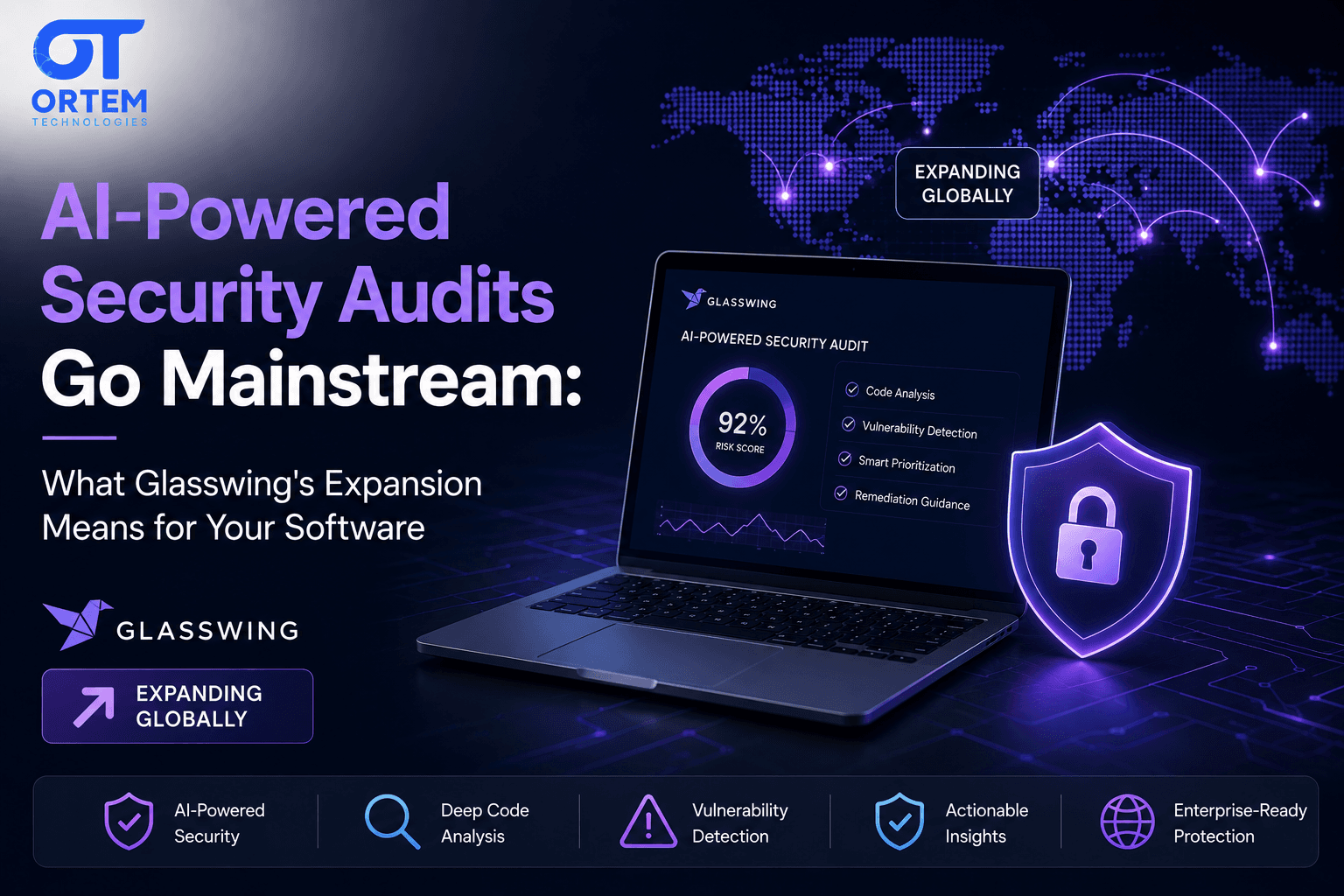
Anthropic's Project Glasswing — a program deploying its restricted Claude Mythos cybersecurity model to find and fix vulnerabilities in critical software — expanded this week from 50 to 150 partner organizations across 15 countries, covering utilities, healthcare systems, and under-resourced open-source projects. The broader signal for businesses: AI-assisted vulnerability discovery is now industrial-scale on both defense and offense, which compresses the time between a vulnerability existing and someone finding it. Companies should respond by shortening their own patch cycles, auditing their dependency chain, and adding AI-assisted security review to development — practices Ortem Technologies builds into its delivery pipeline by default.
AI-powered security auditing uses large models trained for vulnerability discovery to scan codebases, dependencies, and configurations for exploitable flaws at a scale and speed human review cannot match. Anthropic's Project Glasswing, which tripled its deployment footprint in July 2026, is the highest-profile defensive example — and its existence implies the offensive equivalent, which changes patching economics for everyone who ships software.
Commercial Expertise
Need help with Cybersecurity?
Ortem deploys dedicated Cybersecurity Solutions squads in 72 hours.
Next Best Reads
Continue your research on Cybersecurity
These links are chosen to move readers from general education into service understanding, proof, and buying-context pages.
Cybersecurity Services
Turn threat-awareness content into a concrete programme for app security, audits, and remediation.
Explore security serviceCompliance & Security
Review how Ortem handles security controls, governance, and regulated software delivery requirements.
View compliance pageSecure FinTech Case Study
Study a security-sensitive product build where reliability, payments, and trust were central.
Read case studyAnthropic's Project Glasswing tripled its footprint this week — from 50 partner organizations to 150 across 15 countries — deploying its restricted Claude Mythos cybersecurity model to find and fix vulnerabilities in utilities, healthcare systems, and the under-resourced open-source projects half the internet quietly runs on. Unambiguously good news.
Now read it as a signal rather than a headline: vulnerability discovery has industrialized. A model that can find exploitable flaws across critical infrastructure at program scale exists. Capabilities of that class never stay exclusively defensive. The strategic consequence for every company that ships software is a single compressed sentence: the time between a vulnerability existing and someone finding it is collapsing, and your patching cadence was calibrated for the old clock.
What actually changes
The grace period is gone. Vulnerabilities historically enjoyed months or years of obscurity before discovery. AI-assisted scanning — defensive or offensive — shrinks that toward days. "We'll patch quarterly" was a defensible policy under the old discovery economics. It is not under the new ones.
Your dependency chain is your attack surface. Glasswing's inclusion of under-resourced open-source projects is pointed: modern products are mostly other people's code. When the next ecosystem-wide flaw lands, the difference between a bad afternoon and a bad quarter is whether you can answer "which of our systems contain the affected library?" within an hour. That answer requires an SBOM — a software bill of materials — maintained continuously, not reconstructed during the incident.
Continuous review replaces annual review. The annual pentest is now the ceremonial layer of a security program, not the substance. The substance is what runs on every commit.
The practical 2026 security stack
| Layer | What it does | Cost profile |
|---|---|---|
| AI-assisted code review in CI | Flags security patterns at commit time | Low, usage-based |
| Dependency + secret scanning | Catches known-vulnerable libs and leaked keys | Low, mostly free tooling |
| SBOM tracking | Answers "what do we actually run?" instantly | Low once automated |
| Patch-velocity SLOs | Critical fixes shipped in days, not quarters | Process, not tooling |
| Human penetration testing | Business-logic flaws AI misses | Periodic, $10k–$40k |
The AI layer catches scale; humans catch context — authorization logic, workflow abuse, the flaws that require understanding what the software is for. Neither replaces the other, and the combination is now the baseline, not the gold standard.
Built in from day one, this stack adds roughly 10–20% to development cost. Retrofitted after an incident, multiples of that — before counting the incident itself. For regulated work the marginal cost is lower still, because HIPAA and financial-compliance obligations already overlap most of the list. Security-first delivery is standard on our enterprise software engagements for exactly this economic reason.
Questions to ask your vendors this quarter
Your supply chain includes your development partners. Whether you work with us, an internal team, or anyone else, these four questions separate real security posture from a compliance slide: Do you maintain SBOMs for what you ship us? What scanning runs in your CI? What is your patch SLO for critical vulnerabilities in delivered software? When was your last human pentest, and can we see the scope?
Any partner who cannot answer crisply is asking you to carry their risk. (Our answers: yes; secret/dependency/AI-assisted review on every commit; days, contractually; and scoped per engagement.)
The bottom line
Glasswing tripling is the visible half of a structural shift: vulnerability discovery now runs at machine speed in both directions. The response is not fear — it is cadence. Know what you run, scan continuously, patch in days, and hold your vendors to the same clock. Companies that industrialize their defense the way discovery just industrialized will find this shift favors them.
We build security-first software and modernize legacy systems whose security debt has come due — see our enterprise software development and application modernization services, or book a free consultation for a supply-chain and patch-velocity review of your current stack.
About Ortem Technologies
Ortem Technologies is a premier custom software, mobile app, and AI development company. We serve enterprise and startup clients across the USA, UK, Australia, Canada, and the Middle East. Our cross-industry expertise spans fintech, healthcare, and logistics, enabling us to deliver scalable, secure, and innovative digital solutions worldwide.
Get the Ortem Tech Digest
Monthly insights on AI, mobile, and software strategy - straight to your inbox. No spam, ever.
Sources & References
- 1.Top Tech News, July 17 2026 - Tech Startups
- 2.Enterprise Software Development - Ortem Technologies
About the Author
Director – AI Product Strategy, Development, Sales & Business Development, Ortem Technologies
Praveen Jha is the Director of AI Product Strategy, Development, Sales & Business Development at Ortem Technologies. With deep expertise in technology consulting and enterprise sales, he helps businesses identify the right digital transformation strategies - from mobile and AI solutions to cloud-native platforms. He writes about technology adoption, business growth, and building software partnerships that deliver real ROI.
Frequently Asked Questions
- Project Glasswing is Anthropic's program deploying its restricted Claude Mythos cybersecurity model to find and fix vulnerabilities in critical software. In mid-July 2026 it expanded from 50 partner organizations to 150 across 15 countries, covering infrastructure such as utilities and healthcare systems as well as under-resourced open-source projects that much of the software ecosystem silently depends on.
- It compresses timelines on both sides: defenders find flaws faster, and attackers with comparable tooling do too. The window between a vulnerability shipping and someone discovering it — historically months or years — is shrinking toward days or weeks. That makes dependency hygiene, rapid patch cycles, and continuous (rather than annual) security review the new baseline for any company that ships or operates software.
- Yes, as an augmentation, not a replacement. Practical 2026 stack: AI-assisted code review for security patterns in CI, dependency and secret scanning on every commit, SBOM (software bill of materials) tracking so you know what you actually run, and periodic human penetration testing for business-logic flaws AI still misses. The AI layer catches scale; humans catch context.
- A supply chain audit inventories every dependency, vendor component, and build-pipeline step your software relies on, then assesses each for vulnerability exposure and maintenance health. If you cannot currently answer "which of our products contain library X?" within an hour, you need one — that question is exactly what teams could not answer during past ecosystem-wide incidents, and AI-accelerated discovery makes the next one arrive faster.
- Building security in from the start typically adds 10–20% to development cost — threat modeling in discovery, secure defaults, scanning in CI, audit logging. Retrofitting after an incident routinely costs multiples of the original build, before counting breach costs themselves. For regulated sectors (healthcare, fintech), the delta is smaller still because compliance work overlaps heavily with security work.
Stay Ahead
Get engineering insights in your inbox
Practical guides on software development, AI, and cloud. No fluff — published when it's worth your time.
Ready to Start Your Project?
Let Ortem Technologies help you build innovative software solutions for your business.
You Might Also Like
LLM Security Best Practices for Enterprises: The 2026 Checklist
AI Cybersecurity 2026: Surviving Deepfakes & Autonomous Malware